Locomotion and load carrying
Biomechanics of locomotion and load carrying in humans and ants, with a focus on individual and collective coordination.
More about CAB 7 →Université de Toulouse · CBI / CRCA / CAB
From ants to humans
From locomotion to collective load carrying
From exoskeletons to bioinspired systems
This website presents the research, projects, teaching and responsibilities I have developed or coordinated throughout my academic career.
University research and teaching depend on collective effort. This website reports on the work made possible by that commitment and public funding. It is intended for citizens wishing to understand its significance, students and colleagues across disciplines.
Mechano-ethology






Understanding how organisms’ mechanical properties and their interactions contribute to emerging behaviour, then exploring their transfer to bioinspired systems.
Two complementary projects: understanding locomotion and load carrying in humans and ants, then using scaling laws to transfer this knowledge to robotics and exoskeletons.
Biomechanics of locomotion and load carrying in humans and ants, with a focus on individual and collective coordination.
More about CAB 7 →Space–time scaling across sizes: insect efficiency, robotic legs and exoskeletons assisting human collective load carrying.
More about CAB 10 →Instrumentation · Supervision · Collaborations
Developing tools to measure mechanical interactions and understand individual and collective performance.
01 · Instrumentation at the ant scale
How can we measure the tiny forces exerted by each leg of a moving ant? This collaboration with Vincent FOURCASSIÉ and LAAS-CNRS combines biomechanics with optical sensor design. An array of deformable micropillars links camera-recorded displacements to forces in the plane of the substrate.
MANSARD et al. (2026) present a wide-field device for simultaneously measuring in-plane leg forces across several steps, with a reported resolution of 0.5 µN. The project favours an adaptable, robust and low-cost system. Co-authors: Vincent MANSARD, Elliot PERREZ, Dorian GAUTIER, Julien ROUL, Christian BERGAUD, Pierre MORETTO and Vincent FOURCASSIÉ. [1]
This second-year Master’s dissertation documents foot contacts on micropillars and fluorescent tracking. [2] A technique to estimate the normal force component is under investigation.
02 · Rugby and team sports
Thesis supervisor: Pierre MORETTO; co-supervisor: Saad DRISSI. Conducted through a CIFRE industrial PhD at Stade Toulousain, this thesis, defended in 2023, develops an impact-load index from wearable systems. It examines the strengths and limitations of accelerometry for characterising players’ mechanical loading. [3]
The paper by LOKTEFF et al. (2022) analyses two seasons at an elite club. Impact frequency and intensity vary by playing position: backs sustain fewer but more intense impacts than forwards. These findings support adapting load monitoring to positional demands. [4]
Thesis jointly supervised by Pierre MORETTO and Cristian PASQUARETTA, through a CIFRE industrial PhD at Colomiers Rugby, and defended in 2025: Rugby union performance: linking collective indicators and individual impact. This research connects match analysis with team performance. [5]
BÉCHARD et al. (2025) examine 34 matches of a successful team, distinguishing line breaks from open play and set pieces. Dynamic line breaks are associated with a more favourable score difference both at home and away; the association for static line breaks depends more on match location. These results describe one team and one season, rather than establishing a universal rule. [6]
With Thomas BÉCHARD, Pierre MORETTO, Sébastien DÉJEAN and Cristian PASQUARETTA, ODET et al. (2025) propose a method combining machine learning and explainability. A model predicts outcomes from performance indicators; SHAP analysis then clarifies their role at three levels: overall trends, team strengths and weaknesses, and individual match diagnosis. The aim is to make predictions interpretable for analysts and coaches. [7]
This work contributes to research on collective dynamics, which I have supported through doctoral supervision and collaborations leading to Cristian PASQUARETTA’s recruitment. My role in CAB 9 concerns (i) integrating impact detection and quantification into the analysis and prediction of collective movement in sport, and (ii) studying how feedback to players affects individual fitness and team organisation (Project TIRIS Sens-Perf 2026–2030, ongoing). SUSP call — Scaling Up Science Program ↗
CAB 7 project · Comparative biomechanics
From ants to humans · From locomotion to collective load carrying
How do we remain stable while carrying a load? How do intersegmental coordination and interactions between partners influence movement? This project combines behavioural observation, mechanical measurements and modelling to understand these adaptations.
Understanding foot contacts, anatomy and stability during load carrying, then building a biomimetic model.
Previous work · Thesis deposited, 2019
Biomechanics and energetics of locomotion and load carrying in ants. Joint supervision: Vincent FOURCASSIÉ and Pierre MORETTO.
The thesis investigates leg movements, centre-of-mass displacement and energy expenditure in Messor barbarus. It compares workers of different sizes and loads of different masses to understand carrying constraints and their relationship to colony provisioning. [T1]
What the paper shows. Unloaded, larger workers compensate for the imbalance caused by their proportionally larger heads by adjusting their foot contacts. Under load, size-related gait differences decrease; observations suggest that the hind legs grip the ground to limit forward tipping. A simple model shows that scaling alone explains much of the variation in carrying capacity. [1]
Carrying performance therefore also depends on foot contacts and stability, beyond body size alone.
Previous work · Thesis deposited, 2024
Functional morphology and biomechanics of load carrying in ants. Supervisor: Pierre MORETTO; co-supervisor: Vincent FOURCASSIÉ.
This work extends walking observations through functional morphology and articulated ant models, linking anatomical structures to measured movements. [T2]
What the paper shows. The study co-authored with Santiago ARROYAVE-TOBON et al. combines micro-CT, synchronised video and OpenSim simulation. It assesses the reliability of a model of Messor barbarus : under the tested conditions, calculated movements are around four times more sensitive to video-marker placement errors than to uncertainties in joint geometry. [2]
Accurate video tracking is crucial for interpreting movements at such a small scale. This study provides a methodological basis for more comprehensive biomechanical models.
Current research · Ongoing PhD
Barba-Mim: towards a biomimetic model of Messor barbarus in OpenSim. SEVAB doctoral contract.
This ongoing work develops the model by linking anatomical images to a three-dimensional representation suitable for simulation. The animations below show micro-CT segmentation followed by 3D reconstruction. They illustrate model construction; thesis results will be presented as they are validated.
Micro-CT provides cross-sectional images of the animal. Segmentation identifies structures within these sections; assembling them reconstructs the three-dimensional geometry of the cuticle, muscles and apodemes in a digital model.
This geometry supports a dynamic OpenSim model, enabling simulations based on optimisation criteria and comparison with experimentally observed movements.
Animation credit: CBI-CRCA-SVERKALOV 2026.
Understanding how two carriers coordinate their efforts under constraints of mass, precision and assistance.
Previous work · Paper published in 2021
Carrying in pairs: effects of mass on gait and effort distribution. FUMERY et al., 2021. [3]
Question and method. How do two carriers adapt their gait as the load increases? Pairs carry an object weighing 20%, 30% or 40% of their combined body mass. The analysis treats both people and the object as one system, while measuring each carrier’s joint loading.
What the paper shows. Participants shorten their steps and reduce the system’s vertical centre-of-mass displacement. Asymmetries in joint loading and coordination suggest a carrier–guide organisation. Above the 30% condition, joint loading is shared more evenly, while the system’s pendular behaviour deteriorates.
Sharing a load does not mean sharing effort equally: the pair adjusts its cooperation to mechanical constraints.
Previous work · Paper published in 2022
Effects of a precision constraint on collective carrying. SGHAIER et al., 2022. [4]
Question and method. What happens to coordination when carriers must also stabilise the load’s contents? Ten pairs perform ordinary carrying and then the same task while keeping a ball on the object. The study compares the system’s centre-of-mass motion and upper-limb joint forces and moments.
What the paper shows. Precision reduces movement speed and vertical centre-of-mass oscillations. Mechanical energy recovery decreases and partners reorganise their coordination. Upper-limb joint loading becomes better balanced between the carriers.
Precision changes the trade-off between movement economy and effort sharing, complementing FUMERY’s findings on load mass.
Current research · Ongoing PhD
Influence of an artificial exoskeleton on collective load carrying.
This thesis studies ErgoSkel, designed at the Université de technologie de Compiègne (UTC) with Khalil BEN MANSOUR. It aims to quantify how weight relief affects each carrier’s contribution and their division of tasks.
The aim is to understand how mechanical assistance changes the pair’s organisation: how do partners redistribute effort and adjust coordination when carrying conditions change? These questions extend studies of load mass and precision in collective action. Results of this ongoing thesis will be presented after validation.
Collective carrying experiments with and without exoskeletons take place at the F2SMH movement analysis laboratory in Toulouse, on the PRIMH ↗. Chloé KEMANDJOU’s PhD, supervised by Pierre MORETTO.
In ants, earlier work clarifies links between morphology, foot contacts and carrying. In humans, FUMERY and SGHAIER show how mass and precision alter pair coordination. Dmitry SVERKALOV’s and Chloé KEMANDJOU’s ongoing theses extend these approaches through biomimetic modelling and carrying assistance, respectively.
Ultimately, we aim to combine this knowledge to propose a biomimetic exoskeleton and controls suited to collective load carrying. This remains a research objective.
Papers selected from the CV for their direct relevance to CAB 7 and its extension towards CAB 10, supplemented by the Pohod15Leg conference contribution.
SVERKALOV D. Barba-Mim : vers un modèle biomimétique de Messor barbarus sous OpenSim. Ongoing PhD, SEVAB doctoral contract. Topic listed in the CV; illustrations supplied by Pierre MORETTO.
KEMANDJOU C. Influence of an artificial exoskeleton on collective load carrying. Ongoing PhD. Study of ErgoSkel, designed at the Université de technologie de Compiègne (UTC) with Khalil BEN MANSOUR. Topic description supplied by Pierre MORETTO.
From exoskeletons to bioinspired systems · CAB 10 project
Linking locomotion and load-carrying research to bioinspired systems through dimensionless analysis, hexapod robotics and collective carrying assistance.
01 · Shared framework
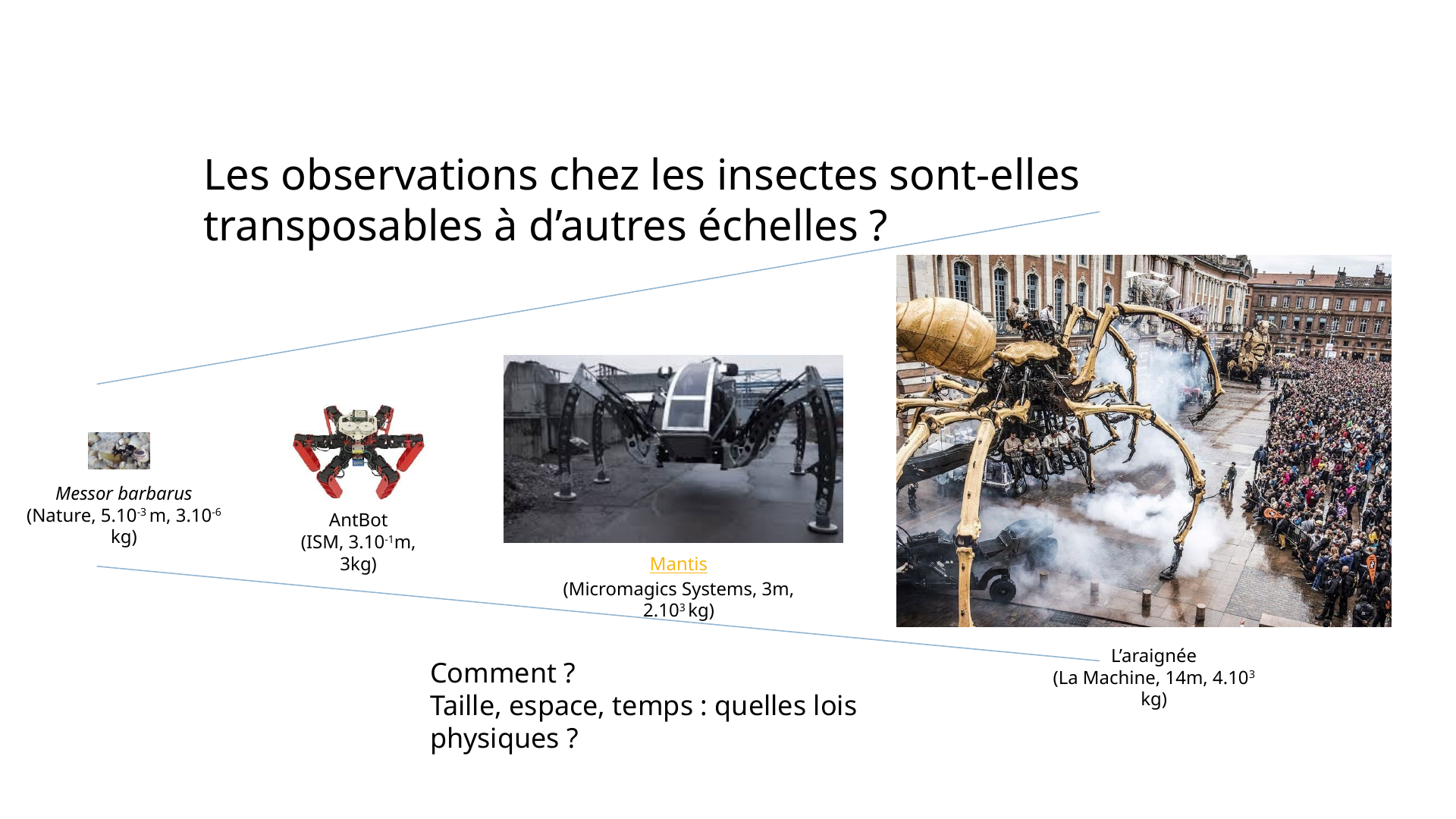
Transferring ant locomotion to a robot requires considering differences in both size and time across scales: space–time scaling. Dimensionless analysis compares systems using unitless numbers identified through the VASCHY–BUCKINGHAM Π theorem. For a given set of physical variables, this theorem determines how many independent dimensionless groups are needed to express their relationships.
From left to right: Messor barbarus (around 5 mm, 3 mg), AntBot (ISM, 30 cm, 3 kg), Mantis (Micromagic Systems, 3 m, 2 tonnes) and La Machine’s spider (14 m, 4 tonnes). These systems illustrate the changes in size and mass involved in transferring insect observations: which physical laws link dimensions, speeds and characteristic times? Pierre MORETTO et al., 2024 ↗
The presentation compares two hypotheses: gravity-dominated dynamics, described by the FROUDE number, and dynamics involving viscosity, described by the REYNOLDS number. The comparisons for Messor barbarus appear more consistent with FROUDE similarity. At constant gravity, this implies that characteristic times and speeds scale with the square root of length.
These relationships guide the choice of step frequencies and joint speeds for a bioinspired robotic leg. Their transfer must also account for materials, stiffness and interactions between segments.
CAB 10 project · From living organisms to artificial systems
From bioinspired legs for hexapod robots to future assistance for collective load carrying.
01 · Hexapod robotics
BRODOLINE et al. present test benches to study and compare an ant leg and a hexapod robot leg. [1] This instrumentation work bridges towards CAB 10: using biomimetic and dimensionless approaches to explore transfer across scales to robotic legs and assistive exoskeletons.
The biomimetic leg Pohod15Leg stems from the research ofIlya BRODOLINEduring his PhD at the Institut des sciences du mouvement (ISM), Marseille, supervised by Julien SERRES and Stéphane VIOLLET. Inspired by the leg geometry of the ant Cataglyphis fortis, it has three degrees of freedom. It is intended for hexapod robots developed in Marseille, such as AntBot. [2]
02 · Research perspective
ErgoSkel V2 aims to bring together the Ant and Human projects to design biomimetic assistance and controls suited to collective load carrying.
Chloé KEMANDJOU’s ongoing work on ErgoSkel, designed at UTC with Khalil BEN MANSOUR, aims to quantify how weight relief affects the carriers’ respective contributions and division of tasks. It may inform this design perspective.
This is a research objective: V2 specifications and results will be clarified as the work progresses.
Explore collective carrying studies in CAB 7 →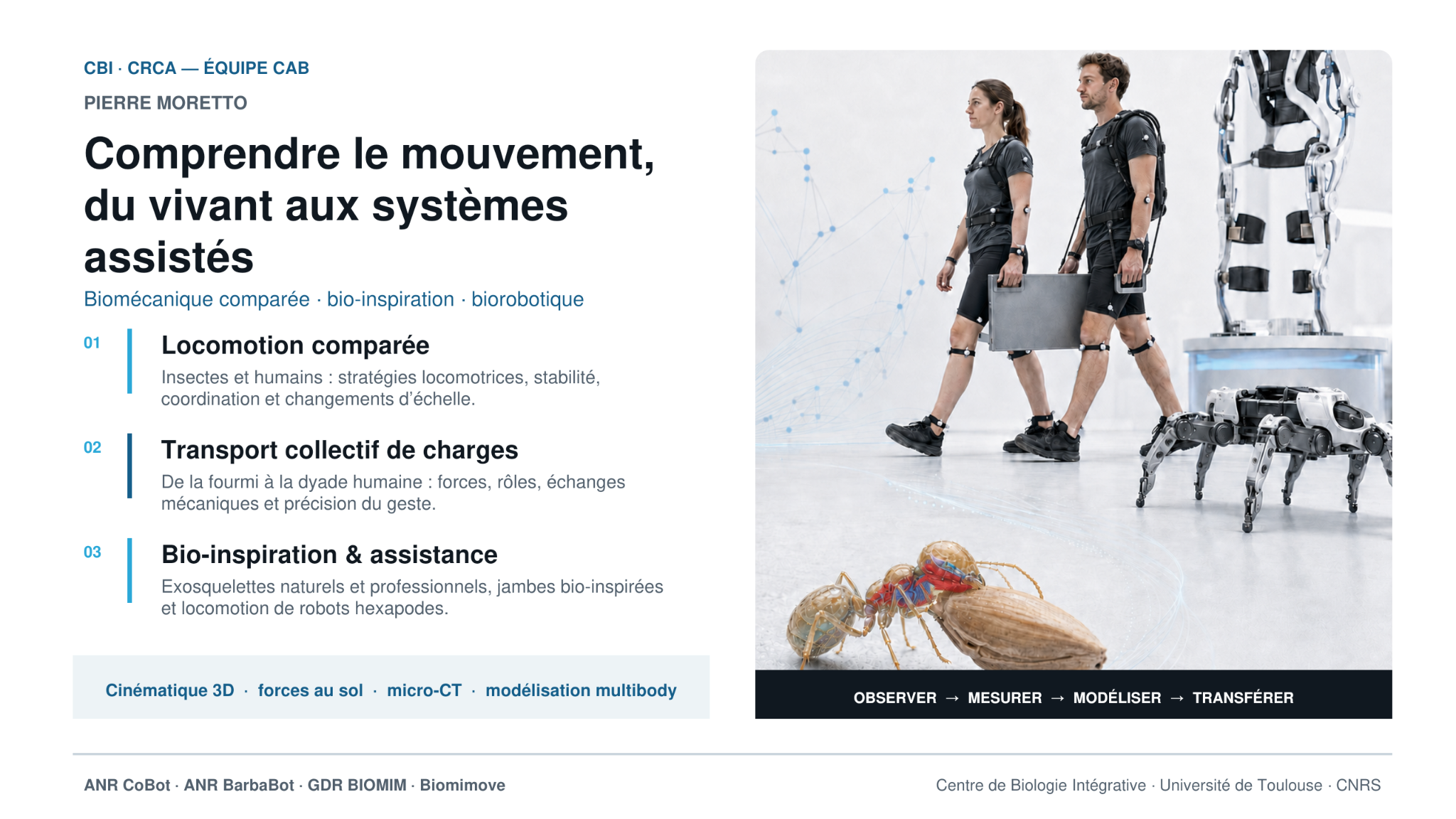
From foundational research to bioinspired systems
FROUDE, STROUHAL and Modela for walking and running; mechanical optimisation and posture changes in cycling.
Having two people walk or run at the same speed does not necessarily create mechanically equivalent tasks. Limb length, step frequency and energy exchange alter movement conditions. Dimensionless analysis seeks to separate size effects from differences in locomotor strategy.
This programme developed through doctoral research by Michaël BISIAUX on walking (2002), Nicolas DELATTRE on dynamic similarity in running (2008), and David VILLEGER on elastic energy return and locomotion (2014). Research byAntony COSTES on cycling (2016), co-supervised with Bruno WATIER, as was David VILLEGER’s thesis, extends the study of mechanical constraints and movement choices.
01 · Walking and running
The FROUDE number, usually written Fr = v²/(gL), compares inertial effects with gravity. It helps choose comparable speeds using a characteristic length, such as leg length. The STROUHAL number, St = fL/v, links movement frequency to speed and length, explicitly introducing step rhythm.
In a running study involving fifteen participants, DELATTRE, LAFORTUNE and MORETTO (2009) show that both numbers provide useful information, but neither alone achieves full dynamic similarity: STROUHAL particularly aligns temporal parameters, whereas FROUDE affects some mechanical parameters. This motivates combining them. [1]
DELATTRE and MORETTO (2008) introduce a dimensionless number from exchanges between kinetic, gravitational potential and elastic energy in a spring–mass model. This formulation, which gave rise to Modela, links the energy balance to a combination of FROUDE and STROUHAL. Initially a modelling result, it was subsequently tested experimentally. [2]
Research by VILLEGER, COSTES, WATIER and MORETTO compares three conditions in nineteen participants: identical speed, FROUDE-adjusted speed, and jointly adjusted speed and frequency. Modela-r for running (2014) and Modela-w for walking (2015) improve similarity and reduce variability in dimensionless mechanical parameters. In the tested protocols, the third condition met similarity criteria for 52 of 54 running parameters and 30 of 36 walking parameters, versus 32 and 22 respectively with FROUDE alone. [3, 4]
Building on Modela’s dimensionless approach, MORETTO et al. (2016) clarify energy exchange in a multi-segment system by relating changes in the spring–mass model’s elastic energy to changes in internal kinetic energy minus the work of internal forces. This highlights how coordination of joint work contributes to an emergent overall stiffness. [8]
The aim is to compare techniques, equipment or populations under better-matched mechanical conditions. These results apply to the tested protocols and do not, by themselves, constitute diagnostic validation.
02 · Cycling
The thesis byAntony COSTES examines optimisation strategies and the seated-to-standing transition on a cycle ergometer, including fatigue effects. The selected papers analyse forces on the bicycle and whole-body coordination as power increases.
COSTES et al. (2015) instrument the saddle, pedals and handlebars and reconstruct body movement. In 25 non-cyclists, increasing pedal forces coincide with a reduction in minimum vertical saddle force. Near the spontaneous transition, handlebar and pedal actions counter upward trunk motion. The findings suggest that saddle unloading contributes to standing up. [5]
Upper-limb analysis also shows that wrist, elbow and shoulder loading increases with power and is greater when standing: pedalling requires a whole-body perspective. [6] Another study links spontaneous transition to minimising cost functions based on joint moments and muscle activity: sitting is more favourable below transition power, standing above it. [7]
Agreement between electromyography and biomechanics. Muscle-activity cost functions, including muscle-volume weighting, and joint-moment cost functions reveal the same trend: sitting is more favourable at low power, whereas standing gains the advantage at high power. This agreement suggests that the transition reorganises mechanical and muscular loading as power increases. [7]
The connection with walking and running is the search for mechanical principles explaining how a strategy emerges. These cycling papers do not validate Modela for pedalling.
This work provides two complementary tools: comparing systems across scales and identifying constraints that shape movement. CAB 10 extends this approach to ants, robotic legs and exoskeletons, checking physical assumptions and material properties at every transfer.
Another branch concerns measuring foot contacts and providing feedback: how can a biomechanical measurement become information that helps a person adapt their movement?
From measurement to movement adaptation
Measuring plantar pressure, providing feedback to the walker and designing assessment and rehabilitation devices.
Baropodometry measures plantar pressure distribution. Biofeedback adds a feedback loop: visual or auditory signals inform people about foot loading and help them voluntarily adjust their gait. The aim is to unload a target area while monitoring pressure redistribution elsewhere under the foot.
Doctoral research by Virginie FEMERY (2003), followed byAurélien DESCATOIRE (2009), at Lille 2, helped develop and evaluate this approach. In Toulouse, research by Laëtitia CLAVERIE (2017), through a CIFRE industrial PhD with Médicapteurs, co-supervised with Anne ILLE, focused on a wearable system for assessing locomotion from plantar pressure.
01 · FEMERY and DESCATOIRE
The study by FEMERY et al. (2008) investigates voluntary partial unloading of the first metatarsal head using visual and auditory signals. Five of eight healthy participants significantly changed their foot loading as requested. However, excessive unloading highlights the need for learning and precise feedback. [1]
BIRD — Baropodometric Information Return Device combines plantar sensors and pressure-threshold feedback. DESCATOIRE et al. describe the device and demonstrate, in feasibility studies, changes in gait strategy to unload a target area. A clinical aim is to provide substitute information when protective foot sensation is impaired. [2, 3]
These studies establish the feasibility of plantar pressure feedback. They do not, by themselves, demonstrate reduced ulcer incidence or long-term clinical effectiveness.
02 · CLAVERIE and Médicapteurs

A wearable system must stay light and simple while accurately describing foot loading. Research by CLAVERIE, ILLE and MORETTO asks where a limited number of sensors should be placed under the foot. The 2015 contribution presents the method; the 2016 paper compares two sensor layouts in the W-inshoe® system against a force platform. [4, 5]
In ten healthy volunteers, the adjusted layout correlates well with the force platform for centre-of-pressure displacement and vertical force. Measurement quality therefore depends on sensor location, not just number. This validation opens possibilities for monitoring outside the laboratory and real-time feedback. [5]
Laëtitia CLAVERIE’s thesis forms part of this collaboration with Médicapteurs. The activity report also describes Olivier GUTIERREZ’s complementary work on auditory gait feedback, linking instrumentation, perception and movement adaptation.
03 · Technology transfer and rehabilitation
Serious Games for Rehabilitation in Seniors — Serious GaRS extends the collaboration with Médicapteurs through regional and European ERDF funding. Developed in response to theEASYNOV 2016 — Silver Economy call, the project was selected for funding reported as 350 k€ in the activity report.
The report describes pressure platforms linked to a gaming environment: participants’ movements control an avatar interacting with a virtual group. Research on collective behaviour, particularly by Guy THERAULAZ and Mathieu LIHOREAU, informs this combination of biomechanics, physical activity and gaming.
The aim is to offer engaging exercises for older adults’ rehabilitation and fall prevention. The report presents prototype development and planned assessments; these objectives are distinguished here from published instrumental validation of the measurement systems.
Explore EASYNOV at Médicapteurs ↗
Tab 02
I teach at the Université de Toulouse, in the Faculty of Sport Sciences and Human Movement (F2SMH) and the Faculty of Science and Engineering (FSI).
My teaching takes an interdisciplinary approach to movement, at the intersection of biology, biomechanics, neuroscience, physics, modelling and robotics. Beyond acquiring knowledge, students are encouraged to understand, model, experiment and solve problems.
This approach has led me to continually update both content and teaching formats: experimental data analysis, programming, simulation, robotics, comparisons of biological and artificial systems, and problem-based learning.
My teaching initiatives also serve the doctoral schools of the Université de Toulouse, introducing doctoral researchers from different disciplines to biomimetics. We have also secured TIRIS funding through the “Minor Programs” call to develop teaching in biomimetics and interdisciplinary dialogue from undergraduate level onwards (project led by Loic TEN-HAGE). Explore the TIRIS teaching programme ↗
Course materials remain restricted to enrolled students. This page presents the teaching principles, themes and original activities developed throughout my teaching.
From undergraduate to doctoral level, teaching uses sensors, video analysis, modelling and practical experiments.
The examples below illustrate learning through experimentation and problem-solving.
Biomechanics · Measurement · Programming
Starting from scientific papers that interest them, students choose a motor skill and design an experiment. In the movement analysis laboratory, they compare a professional reference system, Vicon, used as the gold standard, with more accessible tools: smartphone video and wearable sensors.
Vicon recordings are synchronised with smartphone footage. The orange crosses on the participant serve as landmarks for video movement analysis. A second phone worn by the participant records inertial signals: linear accelerations and rotation data are used to study movement phases.
These activities lead students to process signals, analyse movement biomechanically and program algorithms to calculate relevant parameters. They compare results across devices and discuss capabilities and limitations. Some projects develop biofeedbackapplications that turn measurements into user feedback.
This approach builds skills particularly useful in Master’s programmes in Adapted Physical Activity and Training and Optimisation of Sports Performance (EOPS) : designing measurements, using quantitative movement analysis tools and critically interpreting professional-system or smartphone data.
Ethology · Behaviour · Cognition
In the Master’s programme in Ethology and Comparative Cognition (ECC), students translate behaviour into algorithms. Two groups each program a Thymiorobot to move within an enclosure. Roles are assigned by drawing lots: one group designs the predator’s behaviour, the other the prey’s.
How can a robot detect, pursue or avoid the other while respecting the enclosure’s boundaries? Students specify the information and perception–action rules, then test and adjust their programs.
Bringing the robots together reveals how individual rules generate interaction. The exercise combines behavioural observation, modelling, programming and experimentation.
Doctoral schools · Biomimetics · Collaborative design
Since 2025, the Biomimove meetings have introduced biomimetics through interdisciplinary exchange and practice. Talks provide biological examples; workshops invite participants to turn this knowledge into design ideas.
What is a hackathon? An intensive, time-limited workshop where a team pools its skills to address a challenge and present a proposal. Programming is not always required: here, the aim is to design from biology. This takes the form of a design challenge (créathon) in 2025 and 2026.
In 2025: discover the method, then design. The programme combines an introduction to biomimetic thinking by David MACQUART (CeeBIOS), Magali GERINO (Professor of Ecology) and Pierre MORETTO with a serious game and design challenge on movement, bioinspiration and biomimetics. Groups work across two sessions, then present their projects. This progression links principles, discussion and a shared proposal.
In 2026: drawing on biology to design exoskeletons. The 20 November programme includes an introduction by David MACQUART, followed by workshops on choosing a biological model and the design loop. Organised with Fondation Catalyse, Le Catalyseur and CEEBIOS, the day will end with project presentations and a jury prize.
The teaching ambition. Learn to define a need, identify a relevant biological principle, explain how it works and discuss its transfer to an artificial system. Teamwork develops listening, evidence-based creativity and critical thinking: teams must state their assumptions, the limits of the analogy and the steps needed to test their proposal.
These workshops form part of my commitment to biomimetics education for Master’s and doctoral students and complement teaching development supported by TIRIS through the “Minor Programs” call.
Education · Research · Scientific coordination
Building shared curricula, developing experimental facilities and coordinating scientific communities: three aspects of my collective commitment in Lille, Toulouse and nationally.
Vice-presidency and distance learning.
Movement analysis platform and scientific strategy.
Lille-Nord de France Master’s programme, GDR BIOMIM, Biomimove and HAL.
Teaching responsibilities and inter-university coordination
2006–2009 · Vice-presidency
As Vice-Dean responsible for the “Sciences, ingénierie et métiers du sport” Master’s programme, I organised the six Master’s specialisations offered by the Faculty of Sport Sciences and Physical Education. This formed part of my involvement in faculty governance and teaching.
2003–2009 · Teaching innovation
Alongside this, from 2003 to 2009 I led e-M@ster, devoted to distance learning at Lille 2 and across the Grand Nord network. These responsibilities pooled teaching and research expertise across institutions to structure inter-university research training.
Experimental infrastructure and research development
2013–2020 · Creation and leadership
From 2013 to 2020, I created and directed the F2SMH movement analysis platform in partnership with CREPS Toulouse. This combined developing experimental facilities with building scientific and professional collaborations.
Known as CAAPS and now presented as PRIMH, the platform connects research, performance analysis and human movement applications.
Since 2025 · Research policy
A member of the TIRIS research committee since 2025, I contribute to discussions on scientific priorities and the development of biomimetics as a cross-disciplinary approach.
Explore TIRIS ↗SUSP calls for projects ↗AToUT call for projects ↗
Bringing a community together, organising exchanges and sharing its work
2003–2009 · Grand Nord network
From 2003 to 2009, I led and regionally coordinated the Grand Nord “Sciences du sport” research Master’s, followed in 2008–2009 by the “Lille-Nord de France” STAPS Master’s. Led by Lille 2, the programme was jointly accredited by five universities: Lille 2, Valenciennes et du Hainaut-Cambrésis, Picardie Jules Verne in Amiens, Artois — Liévin campus — and Littoral Côte d’Opale.
This involved coordinating courses and seminars delivered by 65 academics (18 professors, 5 senior lecturers with HDR accreditation to supervise research, and 42 senior lecturers), from 26 research teams and laboratories in Nord-Pas-de-Calais and Picardie. It combined coordination of jointly accredited pathways with liaison with doctoral schools in biology and health, law, humanities and social sciences.
Since 2019 · Scientific coordination
Involved since 2019 in establishing the CNRS GDR 2088 “Biomimetics and Bioinspiration”, whose activities began in 2020, I serve on its scientific council and lead the “Movement, Locomotion, Biomechanics, Biorobotics” theme. This role connects researchers across disciplines to understand animal and human movement and transfer insights to bioinspired systems.
The questions link perception to action, organisms’ mechanical properties to locomotor abilities, and individual coordination to collective behaviour. This theme brings biology, ethology, biomechanics and robotics together: drawing on life to design devices, and using models and robots to test biological hypotheses.
2023 · 2024 · 2025 · 2026
This role takes shape through scientific sessions and the Biomimove meetings on “Animal and Human Movement, Biomechanics, Biorobotics”, under the GDR’s umbrella. Talks present advances; round tables compare methods and identify shared questions; workshops and serious games open biomimetic thinking to collective experimentation. Meetings bring together researchers, doctoral students and technology-transfer partners, including Ceebios and regional innovation organisations.
Through this organisation, I help sustain exchanges and collaborations beyond the meetings themselves. The editions Biomimove 2023, 2024 and 2025, followed by Biomimove 2026, in preparation, give this work continuity through scientific presentations, discussion and hands-on practice.
Open science · Dissemination
The HAL Biomimove collection extends this momentum by sharing work associated with the meetings. It builds a shared scientific record and raises visibility, allowing readers to find deposited documents and continue exchanges between editions. Organising meetings and dissemination through HAL reflect the same commitment: circulating knowledge and making research accessible across disciplines.